A broader range of jump-performance characteristics associated with 50-m sprint performance in older children
Article Sidebar
Main Article Content
Abstract
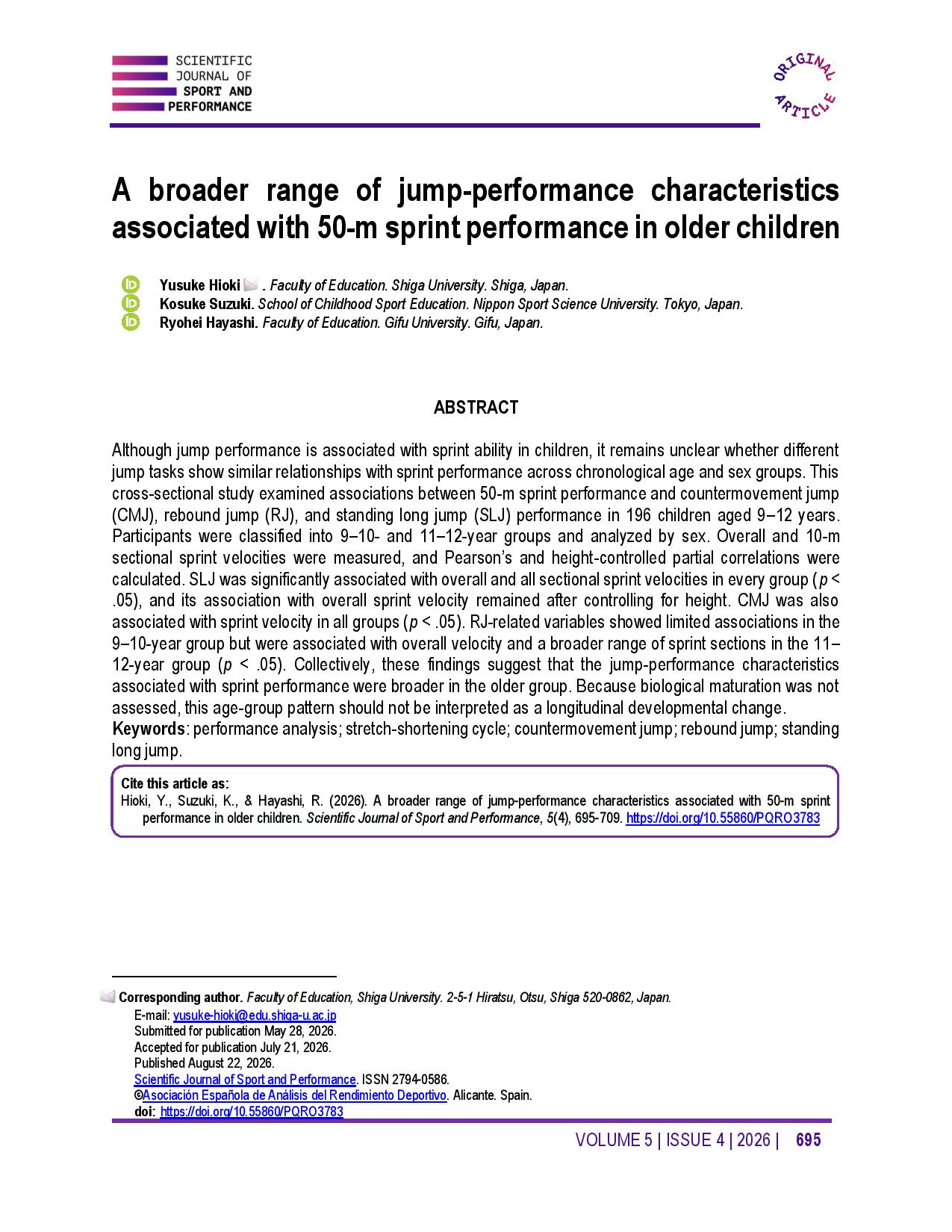
Although jump performance is associated with sprint ability in children, it remains unclear whether different jump tasks show similar relationships with sprint performance across chronological age and sex groups. This cross-sectional study examined associations between 50-m sprint performance and countermovement jump (CMJ), rebound jump (RJ), and standing long jump (SLJ) performance in 196 children aged 9–12 years. Participants were classified into 9–10- and 11–12-year groups and analyzed by sex. Overall and 10-m sectional sprint velocities were measured, and Pearson’s and height-controlled partial correlations were calculated. SLJ was significantly associated with overall and all sectional sprint velocities in every group (p < .05), and its association with overall sprint velocity remained after controlling for height. CMJ was also associated with sprint velocity in all groups (p < .05). RJ-related variables showed limited associations in the 9–10-year group but were associated with overall velocity and a broader range of sprint sections in the 11–12-year group (p < .05). Collectively, these findings suggest that the jump-performance characteristics associated with sprint performance were broader in the older group. Because biological maturation was not assessed, this age-group pattern should not be interpreted as a longitudinal developmental change.
Article Details

This work is licensed under a Creative Commons Attribution-NonCommercial-ShareAlike 4.0 International License.




References
Asmussen, E., & Bonde-Petersen, F. (1974). Apparent efficiency and storage of elastic energy in human muscles during exercise. Acta Physiologica Scandinavica, 92, 537–545. https://doi.org/10.1111/j.1748-1716.1974.tb05776.x DOI: https://doi.org/10.1111/j.1748-1716.1974.tb05776.x
Barnett, L. M., Stodden, D., Cohen, K. E., Smith, J. J., Lubans, D. R., Lenoir, M., Iivonen, S., Miller, A. D., Laukkanen, A., Dudley, D., Lander, N. J., Brown, H., & Morgan, P. J. (2016). Fundamental movement skills: An important focus. Journal of Teaching in Physical Education, 35(3), 219–225. https://doi.org/10.1123/jtpe.2014-0209 DOI: https://doi.org/10.1123/jtpe.2014-0209
Chanel, B., Babault, N., & Cometti, C. (2024). Acceleration capacity and vertical jump performance relationship in prepubertal children. Applied Sciences, 14(8), 3535. https://doi.org/10.3390/app14083535 DOI: https://doi.org/10.3390/app14083535
Cinemre, A., Ünver, E., Ünlü, H. K., & Demirci, N. (2020). A comparison of drop jump and sprint parameters in youth soccer players. Spor Hekimliği Dergisi, 55(2), 148–155. https://doi.org/10.5152/tjsm.2020.171 DOI: https://doi.org/10.5152/tjsm.2020.171
Colyer, S. L., Nagahara, R., Takai, Y., & Salo, A. I. T. (2020). The effect of biological maturity status on ground reaction force production during sprinting. Scandinavian Journal of Medicine & Science in Sports, 30(8), 1387–1397. https://doi.org/10.1111/sms.13680 DOI: https://doi.org/10.1111/sms.13680
Cunha, G. S., Cumming, S. P., Valente-Dos-Santos, J., Duarte, J. P., Silva, G., Dourado, A. C., Leites, G. T., Gaya, A. C., Reischak-Oliveira, Á., & Coelho-E-Silva, M. J. (2017). Interrelationships among jumping power, sprinting power and pubertal status after controlling for size in young male soccer players. Perceptual and Motor Skills, 124(2), 329–350. https://doi.org/10.1177/0031512516686720 DOI: https://doi.org/10.1177/0031512516686720
Demir, A., Hero, M., Juul, A., & Main, K. M. (2023). Sex-independent timing of the onset of central puberty revealed by nocturnal luteinizing hormone concentrations. Clinical Endocrinology, 99(6), 552–558. https://doi.org/10.1111/cen.14974 DOI: https://doi.org/10.1111/cen.14974
Ford, K. R., Myer, G. D., & Hewett, T. E. (2010). Longitudinal effects of maturation on lower extremity joint stiffness in adolescent athletes. The American Journal of Sports Medicine, 38(9), 1829–1837. https://doi.org/10.1177/0363546510367425 DOI: https://doi.org/10.1177/0363546510367425
Guilford, J. P. (1956). Fundamental statistics in psychology and education. McGraw-Hill.
Hioki, Y., Furuhashi, Y., Kasuga, K., & Hayashi, R. (2023). Age-related differences in kinetics during double- and single-leg jumps in boys. The Journal of Sports Medicine and Physical Fitness, 63(4), 550–557. https://doi.org/10.23736/S0022-4707.22.14569-X DOI: https://doi.org/10.23736/S0022-4707.22.14569-X
Komi, P. V. (1984). Physiological and biomechanical correlates of muscle function: Effects of muscle structure and stretch-shortening cycle on force and speed. Exercise and Sport Sciences Reviews, 12(1), 81–121. https://doi.org/10.1249/00003677-198401000-00006 DOI: https://doi.org/10.1249/00003677-198401000-00006
Kotzamanidis, C. (2006). Effect of plyometric training on running performance and vertical jumping in prepubertal boys. Journal of Strength and Conditioning Research, 20(2), 441–445. https://doi.org/10.1519/R-16194.1 DOI: https://doi.org/10.1519/00124278-200605000-00034
Laffaye, G., Choukou, M. A., Benguigui, N., & Padulo, J. (2016). Age- and gender-related development of stretch shortening cycle during a sub-maximal hopping task. Biology of Sport, 33(1), 29–35. https://doi.org/10.5604/20831862.1180169
Lin, J., Shen, J., Zhang, J., Zhou, A., & Guo, W. (2023). Correlations between horizontal jump and sprint acceleration and maximal speed performance: A systematic review and meta-analysis. PeerJ, 11, e14650. https://doi.org/10.7717/peerj.14650 DOI: https://doi.org/10.7717/peerj.14650
Lloyd, R. S., Oliver, J. L., Hughes, M. G., & Williams, C. A. (2011). The influence of chronological age on periods of accelerated adaptation of stretch-shortening cycle performance in pre- and postpubescent boys. Journal of Strength and Conditioning Research, 25(7), 1889–1897. https://doi.org/10.1519/JSC.0b013e3181e7faa8 DOI: https://doi.org/10.1519/JSC.0b013e3181e7faa8
Lloyd, R. S., Oliver, J. L., Hughes, M. G., & Williams, C. A. (2012). Age-related differences in the neural regulation of stretch-shortening cycle activities in male youths during maximal and sub-maximal hopping. Journal of Electromyography and Kinesiology, 22(1), 37–43. https://doi.org/10.1016/j.jelekin.2011.09.008 DOI: https://doi.org/10.1016/j.jelekin.2011.09.008
Malina, R. M., Sławinska, T., Ignasiak, Z., Rożek, K., Kochan, K., Domaradzki, J., & Fugiel, J. (2010). Sex differences in growth and performance of track and field athletes 11–15 years. Journal of Human Kinetics, 24, 79–85. https://doi.org/10.2478/v10078-010-0023-4 DOI: https://doi.org/10.2478/v10078-010-0023-4
Markovic, G., Dizdar, D., Jukic, I., & Cardinale, M. (2004). Reliability and factorial validity of squat and countermovement jump tests. Journal of Strength and Conditioning Research, 18(3), 551–555. https://doi.org/10.1519/00124278-200408000-00028 DOI: https://doi.org/10.1519/00124278-200408000-00028
Meyers, R. W., Oliver, J. L., Hughes, M. G., Lloyd, R. S., & Cronin, J. B. (2016). The influence of maturation on sprint performance in boys over a 21-month period. Medicine & Science in Sports & Exercise, 48(12), 2555–2562. https://doi.org/10.1249/MSS.0000000000001049 DOI: https://doi.org/10.1249/MSS.0000000000001049
Mirwald, R. L., Baxter-Jones, A. D. G., Bailey, D. A., & Beunen, G. P. (2002). An assessment of maturity from anthropometric measurements. Medicine & Science in Sports & Exercise, 34(4), 689–694. https://doi.org/10.1097/00005768-200204000-00020 DOI: https://doi.org/10.1249/00005768-200204000-00020
Morin, J. B., Edouard, P., & Samozino, P. (2011). Technical ability of force application as a determinant factor of sprint performance. Medicine & Science in Sports & Exercise, 43(9), 1680–1688. https://doi.org/10.1249/MSS.0b013e318216ea37 DOI: https://doi.org/10.1249/MSS.0b013e318216ea37
Nagahara, R., Naito, H., Miyashiro, K., Morin, J. B., & Zushi, K. (2014). Traditional and ankle-specific vertical jumps as strength-power indicators for maximal sprint acceleration. The Journal of Sports Medicine and Physical Fitness, 54(6), 691–699.
Oku, K., Kai, Y., Koda, H., Gonno, M., Tanaka, M., Matsui, T., Watanabe, Y., Morihara, T., & Kida, N. (2024). Evolution of key factors influencing performance across phases in junior short sprints. Sports, 12(12), 321. https://doi.org/10.3390/sports12120321 DOI: https://doi.org/10.3390/sports12120321
Okudaira, M., Takeda, R., Hirono, T., Nishikawa, T., Kunugi, S., Igawa, K., Ueda, S., Mita, Y., & Watanabe, K. (2026). Determinants of sprint ability change during maturation in developing children. European Journal of Sport Science, 26(2), e70133. https://doi.org/10.1002/ejsc.70133 DOI: https://doi.org/10.1002/ejsc.70133
Papaiakovou, G., Giannakos, A., Michailidis, C., Patikas, D., Bassa, E., Kalopisis, V., Anthrakidis, N., & Kotzamanidis, C. (2009). The effect of chronological age and gender on the development of sprint performance during childhood and puberty. Journal of Strength and Conditioning Research, 23(9), 2568–2573. https://doi.org/10.1519/JSC.0b013e3181c0d8ec DOI: https://doi.org/10.1519/JSC.0b013e3181c0d8ec
Peñailillo, L., Espíldora, F., Jannas-Vela, S., Mujika, I., & Zbinden-Foncea, H. (2016). Muscle strength and speed performance in youth soccer players. Journal of Human Kinetics, 50, 203–210. https://doi.org/10.1515/hukin-2015-0157 DOI: https://doi.org/10.1515/hukin-2015-0157
Petrigna, L., Karsten, B., Marcolin, G., Paoli, A., D’Antona, G., Palma, A., & Bianco, A. (2019). A review of countermovement and squat jump testing methods in the context of public health examination in adolescence: Reliability and feasibility of current testing procedures. Frontiers in Physiology, 10, 1384. https://doi.org/10.3389/fphys.2019.01384 DOI: https://doi.org/10.3389/fphys.2019.01384
Quatman, C. E., Ford, K. R., Myer, G. D., & Hewett, T. E. (2006). Maturation leads to gender differences in landing force and vertical jump performance: A longitudinal study. The American Journal of Sports Medicine, 34(5), 806–813. https://doi.org/10.1177/0363546505281916 DOI: https://doi.org/10.1177/0363546505281916
Radnor, J. M., Oliver, J. L., Waugh, C. M., Myer, G. D., Moore, I. S., & Lloyd, R. S. (2018). The influence of growth and maturation on stretch-shortening cycle function in youth. Sports Medicine, 48(1), 57–71. https://doi.org/10.1007/s40279-017-0785-0 DOI: https://doi.org/10.1007/s40279-017-0785-0
Retzepis, N.-O., Avloniti, A., Kokkotis, C., Stampoulis, T., Balampanos, D., Gkachtsou, A., Aggelakis, P., Kelaraki, D., Protopapa, M., Pantazis, D., Emmanouilidou, M., Zaras, N., Draganidis, D., Smilios, I., Kambas, A., Fatouros, I. G., Michalopoulou, M., & Chatzinikolaou, A. (2025). The effect of peak height velocity on strength and power development of young athletes: A scoping review. Journal of Functional Morphology and Kinesiology, 10(2), 168. https://doi.org/10.3390/jfmk10020168 DOI: https://doi.org/10.3390/jfmk10020168
Talukdar, K., Harrison, C., & McGuigan, M. R. (2022). Natural development of sprint speed in girls and boys: A narrative review. The Journal of Sport and Exercise Science, 6(3), 153–161. https://doi.org/10.36905/jses.2022.03.02 DOI: https://doi.org/10.36905/jses.2022.03.02
Tottori, N., & Fujita, S. (2019). Effects of plyometric training on sprint running performance in boys aged 9–12 years. Sports, 7(10), 219. https://doi.org/10.3390/sports7100219 DOI: https://doi.org/10.3390/sports7100219
Veligekas, P., Tsoukos, A., & Bogdanis, G. C. (2012). Determinants of standing long jump performance in 9–12-year-old children. Serbian Journal of Sports Sciences, 6(4), 147–155.
Warneke, K., Wagner, C. M., Konrad, A., Kadlubowski, B., Sander, A., Wirth, K., & Keiner, M. (2023). The influence of age and sex on speed-strength performance in children between 10 and 14 years of age. Frontiers in Physiology, 14, 1092874. https://doi.org/10.3389/fphys.2023.1092874 DOI: https://doi.org/10.3389/fphys.2023.1092874
Wu, H., Li, S., Lai, J., Bian, W., Ramirez-Campillo, R., Sáez de Villarreal, E., & Zhao, Q. (2025). Children’s sprint and jump performance after plyometric-jump training: A systematic review. Journal of Sports Science & Medicine, 24(1), 52–74. https://doi.org/10.52082/jssm.2025.52 DOI: https://doi.org/10.52082/jssm.2025.52
Yanci, J., Los Arcos, A., Castillo, D., & Cámara, J. (2017). Sprinting, change of direction ability and horizontal jump performance in youth runners according to gender. Journal of Human Kinetics, 60, 199–207. https://doi.org/10.1515/hukin-2017-0103 DOI: https://doi.org/10.1515/hukin-2017-0103